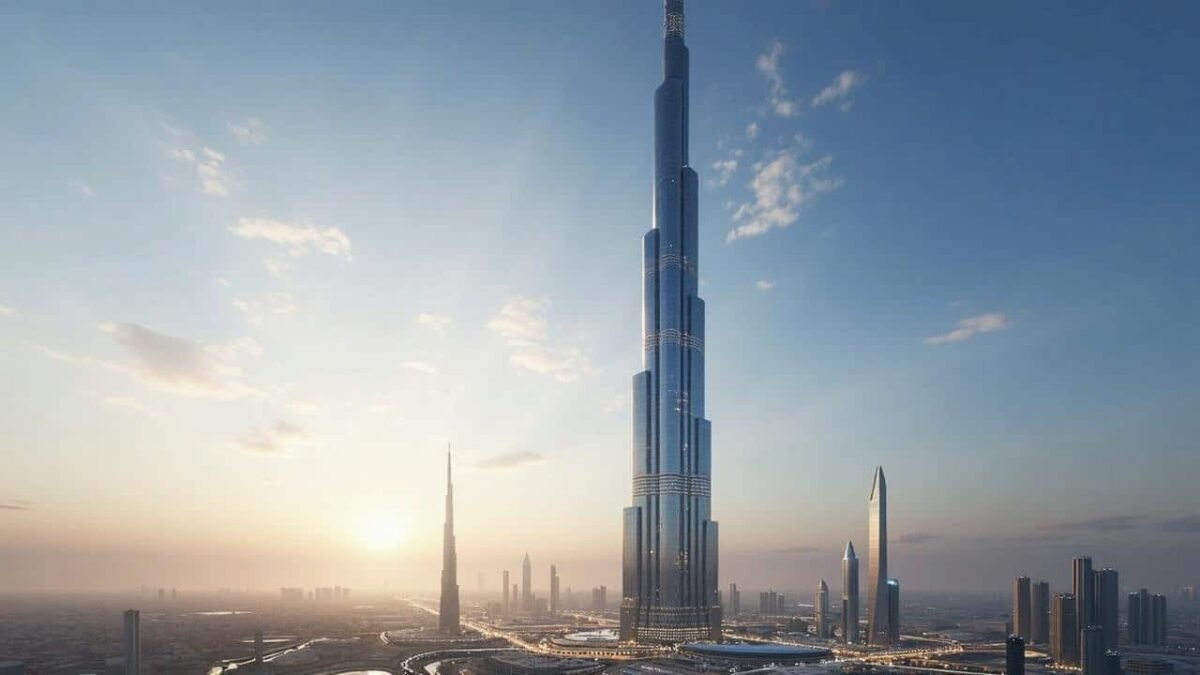
From the observation deck of the Burj Khalifa, Dubai looks like a toy city scattered across a beige carpet. People press their faces to the glass, whispering numbers: 828 meters, 163 floors, tallest in the world. For years, that title felt almost unbreakable, like Everest before oxygen tanks and commercial expeditions. It stood as the ultimate testament to human ambition and engineering prowess. But the skyline is a restless place, and dominance is rarely permanent.
A thousand kilometers away, across an even harsher stretch of desert, Saudi Arabia is quietly sketching something that makes the Burj look almost modest. Engineers shuffle 3D models. Investors watch wind-tunnel tests. Politicians talk about “vision” with a straight face. Somewhere in those meeting rooms, one number keeps coming back: 1,000 meters. And this time, the ambition isn’t just height; it is a fundamental reimagining of what a vertical city can be and what it represents in the 21st century.
A desert that wants to scrape the sky
Picture the outskirts of Jeddah at sunrise: pale light on empty sand, the Red Sea still a dark strip on the horizon. Then imagine, in that stillness, a needle of glass and steel rising so high it almost stops looking real. That’s the scale of the planned 1,000-meter skyscraper in Saudi Arabia — a building designed to stare down the Burj Khalifa and Shanghai Tower and ask, “Your move.”
This project, often referred to as Jeddah Tower, isn’t just another “world’s tallest” headline. It’s a statement of intent from a country trying to rewrite its story, shifting from oil wells to vertical cities. One kilometer into the sky is not just engineering. It’s a symbol, almost a provocation. It represents a pivot toward a future where economic identity is built on innovation, tourism, and global status rather than natural resources alone.
Numbers around it feel surreal. Early plans spoke of more than 200 floors, high-speed double-deck elevators, and a viewing platform around 600–700 meters in the air. To put it bluntly: what used to be the domain of CGI artists is now a spreadsheet line item. Saudi Arabia is betting that our appetite for height, spectacle, and future-city imagery hasn’t even peaked yet. The project is designed to be a vertical community, a “micro-city” that houses thousands of residents, workers, and tourists in a single, soaring structure.
In the background, the competition is real. Dubai’s Burj Khalifa still dominates postcards and drone shots. Shanghai Tower curls into the sky like a steel ribbon, boasting the world’s highest observation deck. But a 1,000-meter tower changes the grammar of skylines. It makes everything else look… short. Suddenly, what felt impossible yesterday becomes a benchmark for tomorrow. That’s how quickly our sense of “normal” gets stretched. It forces architects and urban planners globally to rethink the limits of the possible.
How do you even build a kilometer-high tower?
Behind the glossy renders and viral Twitter threads, the reality is messy, technical, and a bit brutal. A tower this tall has to survive winds that push against it like a slow, relentless storm. Its foundations must bite deep enough into the ground to carry the weight of a small vertical town. Concrete isn’t just poured; it’s engineered like a designer perfume recipe, requiring specific admixtures and curing processes to achieve the necessary strength and durability.
The basic idea is a super-strong core, like a spine, surrounded by structural “wings” that break up the wind and stop the building from swaying too much. Engineers talk about “tuned mass dampers” — huge weights that move slightly to counteract motion, so people on the 150th floor don’t feel like they’re on a ship at sea. It’s the quiet side of megaprojects: endless simulations, lab tests, and meetings over what kind of glass can survive a decade of desert sandstorms without degrading or losing thermal efficiency.
Then there’s the human part. Elevators need to move thousands of people a day without turning the lobby into an airport queue. Cooling systems must handle heat that fries car dashboards in minutes. Fire safety in a building of that height demands redundancy on top of redundancy. This is where fantasy meets fire codes, and where ambitious lines on a vision board collide with local regulations, supply chains, and actual weather. Every system, from plumbing to data networks, must be designed with catastrophic failure in mind, ensuring that a problem in one section doesn’t cascade into a total building shutdown.
Some early phases of the Saudi 1,000-meter tower already revealed how tricky the path is. Construction began years ago, paused, then lurched forward and back again as costs, politics, and global economics collided. Attempting a kilometer-high skyscraper is not like adding another generic tower to a skyline. It’s like building a prototype car that also needs to work as a city bus from day one. That tension — between dream and daily life — is exactly what makes this project so magnetic to watch. It serves as a real-time case study in high-stakes project management and international finance.
What this skyscraper really means for the rest of us
If you’re not an engineer or an investor, you might wonder why any of this should matter. A shiny tower in Saudi Arabia can feel very far away when you’re stuck in traffic or paying rent in a cramped apartment. Yet megastructures like this tend to ripple quietly into everyday life long after the headlines move on. The technologies pioneered here often become the standards of tomorrow, influencing safety codes, construction materials, and energy management systems in buildings everywhere.
Think of how the Burj Khalifa reshaped Dubai’s image almost overnight. It turned an already ambitious city into a global symbol of “the future”, for better or worse. A 1,000-meter tower in Saudi Arabia plays a similar role, but at an even more aggressive scale. It says to tourists, startups, architects, and influencers: look here, something is happening. And like it or not, attention changes flows of money, talent, and imagination. It can turn a region into a magnet for creative minds and venture capital, creating a halo effect that benefits the entire economy.
On a colder level, projects like this push materials science, AI-driven design, and energy efficiency further. The cooling systems tested for a super-tall tower don’t stay locked in some royal vault. They trickle down into more ordinary buildings. New types of glass, smarter sensors, better elevator algorithms — these often start as “luxuries” in crazy-tall towers and end up standards in regular offices or even mid-range housing. Height becomes an excuse to innovate, driving a cycle of improvement that benefits the construction industry as a whole.
There’s also the question we don’t always ask out loud: what story are we building into our skylines? A kilometer-high tower in the desert raises uncomfortable issues about sustainability, water use, and social inequality. On a planet struggling with climate anxiety, firing up a project of this scale sounds almost defiant. *Is reaching higher the answer, or are we trying to distract ourselves from the ground under our feet?* The paradox is that the same technologies that make such a tower possible could also help us build greener, fairer cities — if we choose to aim them differently. The tower forces a conversation about how we balance symbolic progress with ecological responsibility.
How Saudi Arabia wants this tower to change the game
For Saudi Arabia, the 1,000-meter skyscraper isn’t only about beating Dubai in a height contest. It’s a piece of a much larger puzzle: Vision 2030, the country’s huge plan to diversify its economy away from oil and turn itself into a global hub for tourism, tech, and finance. The tower is like an exclamation mark on that sentence. Or maybe a flare fired into the global skyline. It is a marketing tool as much as a building, designed to signal that the nation is open for business and ready to compete on the world stage.
The method is simple on paper: build something so staggering that the world can’t ignore it. Wrap it in a narrative about innovation, sustainability, and opportunity. Then use the resulting spotlight to attract conferences, headquarters, influencers, movie shoots, and waves of curious visitors. We’ve seen this play out before — from Malaysia’s Petronas Towers to London’s Shard — but a structure brushing 1,000 meters kicks the strategy into a higher gear. It creates a focal point for the nation’s soft power strategy.
Where this gets more interesting is the push toward mixing functions inside the building. Not just offices at the top and shops at the bottom, but a vertical blend of luxury apartments, hotels, gardens, observation decks, and maybe even clinics or schools. A skyscraper like this doesn’t just dominate the skyline; it tries to function as a mini-city. If it works, expect to see more “hyper-mixed” towers worldwide, especially in dense or land-scarce regions. This model could redefine urban planning by condensing entire districts into single, connected vertical structures.
On a human level, we’ve all had that moment where a single building changes how we feel about a place. A childhood view of a TV tower, a first trip to New York, the way a skyline looks from a plane window. Saudi Arabia is trying to manufacture that feeling at an extreme frequency. It’s betting that awe is an economic asset. By creating a landmark that dominates the global architectural conversation, it aims to capture the imagination of a generation, inspiring a new wave of ambition within its own population.
“These types of projects are not just about top floors,” one urban planner told me. “They’re about who gets to write the next chapter of what a city is meant to be.” That chapter won’t be written by architecture alone. The tower’s real impact will depend on things that don’t show up in renders. How accessible the spaces are to ordinary residents, not just VIPs. Whether the jobs created are meaningful, long-term roles or short bursts of construction work. How seriously energy, water, and climate resilience are handled beyond the marketing taglines. These are the metrics that determine whether a megaproject is a genuine asset or just a vanity trophy.
A new North Star for the world’s skylines?
Standing at the base of a future 1,000-meter tower, you’d probably feel very small. The desert would hum with cranes, trucks, and the constant clatter of construction. High above, the top floors would still be imaginary: pixels on screens, lines on permits, arguments in meeting rooms. That gap — between what’s already built and what’s only dreamed — is where the whole story sits. It is a monument to the tension between current capabilities and future aspirations.
Forget the Burj Khalifa and Shanghai Tower for a second. They were once the wild dreams, and now they’re postcards and Instagram backgrounds. A Saudi kilometer-high skyscraper hints at the next cycle: taller, smarter, more performative buildings, built not just for people who live in them, but for a global audience that experiences them through reels, drone shots, and glossy documentaries. It’s architecture as content, and content as soft power. The building is designed to be photographed, streamed, and talked about, becoming a character in the global narrative of the 21st century.
Whether you find that exciting, worrying, or a bit of both, this project forces a question that goes beyond engineering: what do we want our cities to say about us? Are we chasing height for bragging rights, or using it as a scaffold to rethink how we live, work, and share space? The answers will define the skylines of the coming decades, determining if our vertical growth is driven by ego or by genuine innovation that improves the human experience.
Skylines have always been a mirror of ambition. If Saudi Arabia really sends a structure 1,000 meters into the sky, the reflection we get back might surprise us. It might make smaller cities rethink their own modest towers. It might push architects to prioritize resilience as much as spectacle. Or it might simply remind us that, even in an age of climate warnings and economic uncertainty, humans still can’t resist drawing a taller line on the horizon — and daring reality to catch up.
Will the Saudi 1,000-meter tower really be taller than the Burj Khalifa?
Is the project confirmed and fully funded?
Where exactly will this skyscraper be located?
Can ordinary tourists visit it once it’s finished?
How will a building this tall handle sustainability and climate concerns?