The wind starts long before you see the sand. It comes in sharp, dry bursts that sting the skin and leave a bitter taste on your tongue. On the horizon, the Gobi Desert looks like a beige ocean pushing slowly toward villages, roads, and power lines, swallowing everything soft and fragile in its path. Then the landscape shifts. A hard line of green appears, almost unreal, rows of young poplars and pines standing like soldiers against the dunes. Their trunks are thin, their shadows short, but they draw a border where there was none before. A man in a dusty jacket pats the soil around one sapling with his boot and smiles without saying a word.
This is China’s bet against the desert. And the wager is measured in tens of billions of trees.
The Great Green Wall rising from the sand
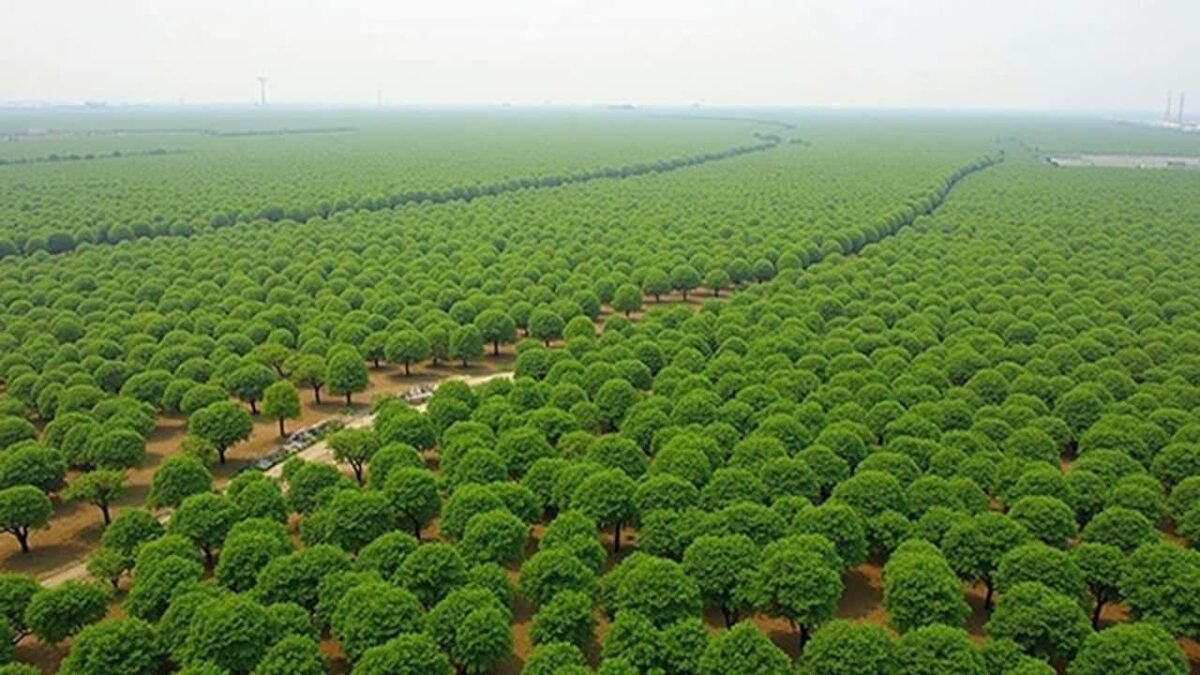
On satellite images, northern China looks like a battlefield between two colors: the pale yellow of spreading deserts and the darker green of human insistence. The so‑called “Great Green Wall” – or Three-North Shelterbelt Program – stretches across thousands of kilometers, from Xinjiang in the west to Liaoning in the east. It’s not a single line of trees, but a huge mosaic of forests, shrubs, windbreaks, and grassland restoration.
In some places, the “wall” is a dense pine forest. In others, it’s just scattered rows of drought-hardy shrubs. Walking through it, you sometimes hear only the sound of wind through needles and the scratch of sand hitting bark. It feels fragile. And yet, this patchwork of green is now one of the largest ecological projects on Earth.
The scale is almost hard to process. Since the late 1970s, China says it has planted or encouraged the growth of tens of billions of trees in its northern regions. Entire counties have been reshaped by planting campaigns: schools sending students to plant saplings, soldiers digging pits in frozen ground, local farmers paid to convert fields into shelterbelts. Official data suggests forest coverage in key northern areas has increased, and satellite records show a real greening trend.
In Inner Mongolia, villagers talk about how, years ago, sandstorms would turn noon into dusk. Some recall trucks buried overnight, crops shredded by wind, and doors sealed with wet cloth just to keep the dust out. Now, they point to belts of poplars behind their houses and say the storms hit less often, or at least with less biting force. Numbers back part of that story: in some cities like Beijing, the frequency of the worst sandstorms has dropped compared to the 1990s.
The Great Green Wall hasn’t just changed the scenery. It has created new routines, new incomes, new ways of living with a land that once felt unlivable. Some residents run small nurseries, growing seedlings for nearby projects. Others rent their land to government-backed forestry programs. Ecotourism is starting to appear around a few reforested areas. One project can mean jobs for planters, drivers, irrigation workers, technicians. A forest is not just trees; it’s a web of human tasks and small hopes.
At the same time, scientists and local people are starting to ask harder questions. Not every planted tree survives. Some plantations were laid out without fully understanding local soils or water cycles. In very dry zones, thirsty trees may compete with groundwater used by communities. *A forest in the wrong place can become another kind of problem.* The idea of the Great Green Wall is seductive. The reality is more tangled, more human, more uncertain.
How China is trying to make the desert move back
Behind the poetic image of a “green wall” lies a very practical toolkit. The first method is simple but exhausting: plant, plant, plant. Workers dig holes by hand or with machines, often in checkerboard patterns that hold sand in place. They drop in seedlings of hardy species like poplar, Mongolian Scots pine, saxaul, or shrubs adapted to low rainfall. Sometimes they stabilize dunes first with straw grids, creating a rough net that catches sand and moisture.
Water is the real currency. In some regions, drip irrigation lines wind between the saplings, feeding them just enough to survive their first years. Elsewhere, planners rely on timing: planting only in short windows when spring snowmelt or rare rains moisten the land. There’s also a push toward using more native species that can grow deep roots and cope with years of drought. The goal is not just a burst of green, but vegetation that can outlive the funding cycle.
Policy changes are another tool, less visible than the trees but just as decisive. Large areas of pasture have been fenced off under “grain-to-green” or “grazing bans,” giving grassland a chance to recover from decades of overuse. In remote spots, local herders moved into new housing so their animals wouldn’t keep eating the regrowing plants. That shift is controversial and emotionally hard. On a human level, it means old ways of life broken and new ones not always fitting right.
On a national scale, the program links to China’s climate and energy ambitions. As the country pledges to peak carbon emissions and expand renewables, it also counts on forests as giant carbon sponges. Tree planting feeds into that narrative, into global climate talks, into domestic pride. Yet the people digging holes at the desert’s edge often talk less about carbon and more about sand not blowing into their soup. Big goals meet small daily needs in the same dusty field.
Soyons honnêtes : personne ne suit tous ces plans et cartes officielles depuis son canapé. What most of us remember are images and stories – the old man who planted thousands of trees alone, the schoolkids lined up with shovels, the before-and-after photos of bare dunes turned into patchy woodlands. These mini-myths travel fast online and shape how the world sees China’s experiment.
Where the Great Green Wall works… and where it cracks
For planners, the most powerful “method” now is learning from the early mistakes. One key shift is moving away from rigid monocultures. Instead of endless rows of a single species, many new projects mix trees, shrubs, and grasses that naturally fit the local ecosystem. This layered approach protects soil better and handles wind and drought with less human intervention. It also attracts more birds and insects that help keep the whole system alive.
Another practical step is letting some areas grow back on their own. In places where there’s still a seed bank in the soil, or patches of surviving vegetation nearby, simply fencing off land and reducing pressure can trigger natural regeneration. It’s slower and less photogenic than a big planting ceremony, but it often creates more resilient landscapes. On a map, these zones look like irregular green stains, not neat stripes – messy, but often more real.
On a human scale, success also means involving locals in choosing what grows. Some communities now mix economic trees like jujube, apricot, or medicinal plants with shelterbelts, so the wall doesn’t just block sand, it feeds families. That’s a quiet but crucial evolution: from planting “for the state” to planting for shared survival. When the trees become part of daily life, not a distant policy, they get watered, protected, and talked about.
There are, of course, recurrent traps. One of the biggest is water. In arid Inner Mongolia or Ningxia, planting thirsty species can worsen water stress. Some early plantations dried up after a few years because groundwater dropped or irrigation became too costly. The forest turned brittle, then faded, leaving half-dead trunks scattered like bones. Experts now warn against forcing forests where steppe or shrubland would be healthier.
Another frequent misstep is chasing short-term numbers. Local officials, under pressure to hit targets, have sometimes favored quick-growing, uniform plantations that look good in reports. Survival rates, years later, tell a different story. On a personal level, many villagers feel tired of repeated planting drives that don’t always pay off. On a visceral level, that fatigue shows in how people talk about “campaign seasons” — the buses arriving, the speeches, the flags, then the silence after everyone leaves.
On a more emotional note, on a windy spring day when the air goes brown and phones buzz with sandstorm alerts, that fatigue can turn into something closer to fear. On a screen, deserts seem distant and abstract. At your window, when the glass rattles and the sky turns the color of rust, they feel very close.
“You can’t just fight sand with trees,” says one Beijing-based ecologist. “You have to work with the climate, the soil, the local people. A wall is rigid. Landscapes are not.”
That tension – between the clean metaphor of a “wall” and the messy reality of ecosystems – runs throughout the project. Still, there are lessons that keep coming back, almost like rules scratched into the desert itself:
* Plant fewer, better-chosen species that match local rainfall.
* Mix trees with shrubs and grasses rather than chasing a dense, dark forest.
* Protect water resources first; every new sapling is a long-term commitment.
* Give space to natural regeneration where the land can heal itself.
* Involve residents so the green belt becomes part of their economy, not just a backdrop.
What this giant experiment says about our future
China’s Great Green Wall is not just an environmental project; it’s a mirror. It reflects how far a country is ready to go to hold back a creeping crisis, and how much uncertainty it accepts along the way. The question behind it is almost painfully simple: when nature starts to move – when deserts spread, seas rise, forests burn – how much can we push back?
For other regions fighting desertification, from the Sahel in Africa to parts of Central Asia, China’s approach offers both inspiration and caution. The message is not “plant trees everywhere,” but something more complex: mix ambition with patience, and aerial photos with muddy boots. A satellite can see greening trends. It can’t hear the farmer wondering if his well will dry faster next summer.
There’s also a quieter, almost private echo in this story. On a personal level, we all have our own “advancing deserts” – problems that grow grain by grain until they feel unstoppable. The image of villagers standing in front of dunes, digging holes and dropping in fragile saplings, is oddly relatable. On a human scale, it’s not about winning forever. It’s about buying time, reshaping habits, choosing where to draw a line and say, softly but firmly: here, the sand stops.
What exactly is China’s “Great Green Wall” project?
Has the Great Green Wall really stopped the deserts?
Are all the planted trees surviving?
Does this project help fight climate change?
Could other countries copy China’s Great Green Wall?