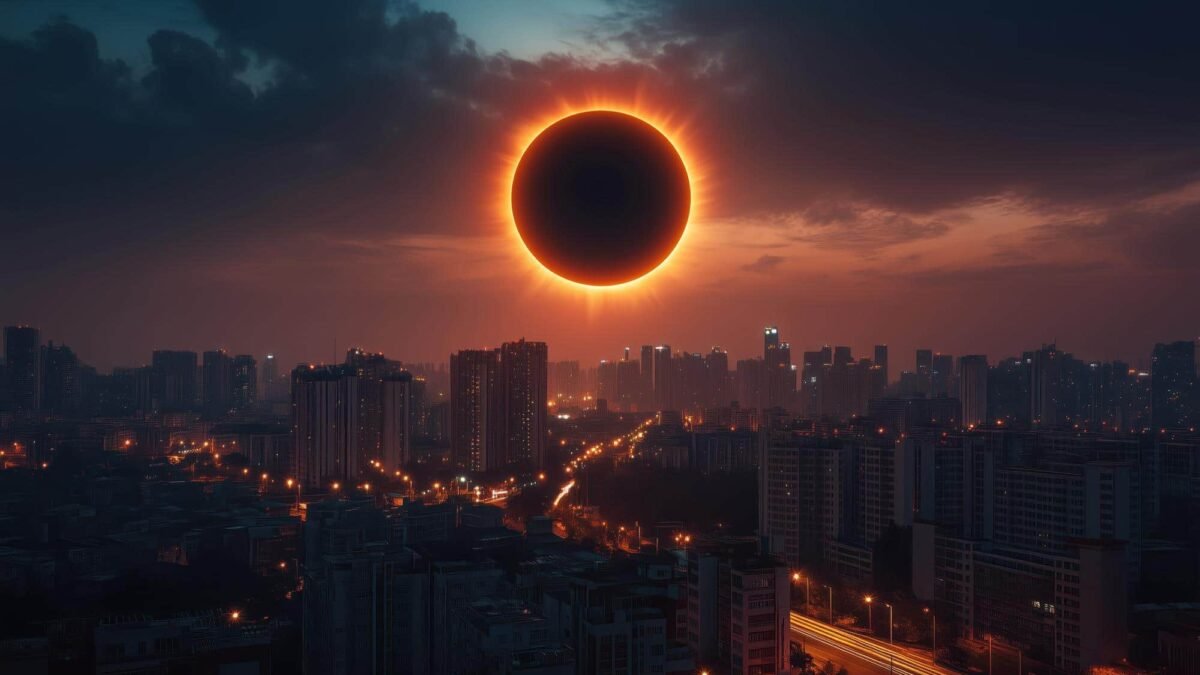
A dog starts barking, then falls eerily silent. You look up and the world has the strange colour of an overexposed photograph. Shadows sharpen, the temperature dips and a wave of cheers, screams and stunned silence ripples across the crowd. Someone near you is crying. Another person is laughing, almost nervously, phone forgotten in their hand. Above you, the last bead of sunlight slips behind the Moon and, just like that, day dies in the middle of the afternoon.
For six long minutes, the Sun becomes a black hole in the sky, ringed by ghostly white fire. Venus pops out. Birds are confused. Your brain, frankly, doesn’t know what to do with all this. Then a single ray explodes on the edge of the disc and people gasp like they’re watching the universe breathe. That’s the promise of the eclipse of the century.
Eclipse of the century: why six minutes of darkness matter so much
A full six-minute total solar eclipse is the kind of event future astronomers will be jealous of. The absolute maximum possible duration of totality on Earth hovers around 7 minutes 32 seconds, and even that is incredibly rare. So when forecasts for the late 21st century started pointing to an eclipse passing that magical six‑minute mark, researchers quietly began circling dates in red. This “eclipse of the century” is currently expected in the 2090s, with the strongest candidate around the year 2094, when the geometry of Sun, Moon and Earth lines up almost perfectly.
It’s the celestial version of hitting a hole-in-one on a moving golf course. The Moon will be near perigee (its closest point to Earth), the Earth near aphelion (its farthest point from the Sun), and the eclipse path will skim the equator, where the planet’s spin gives the shadow a little extra speed. To get a sense of scale, think back to the big total eclipses of the 21st century so far. On 22 July 2009, parts of China, India and the Pacific saw up to 6 minutes 39 seconds of totality, the longest in more than a century. People travelled halfway around the world for those extra seconds of darkness. Many of them still talk about it as the most intense natural event they’ve ever seen.
Now imagine a similar spectacle, but choreographed for the age of ultra-precise forecasting, cheap flights and global livestreams. Not everyone will get the full six minutes, of course. Only those standing inside the thin path of maximum totality, sometimes just a few dozen kilometres wide, will see the longest blackout. Just a short drive away, totality can shrink to two minutes or less. That’s why eclipse chasers obsess over maps, timing tables and local weather statistics years in advance. They know that an extra 90 seconds in the Moon’s shadow can change the whole emotional weight of the day.
When and where: the best places on Earth to watch the eclipse of the century
Right now, long-range calculations suggest that the standout “six-minute eclipse” of this century will arrive late in the 2090s, likely around 2094. The exact date and time will be refined as we get closer, but the math already tells a clear story: the path will slice across the tropics, where the orbital geometry lets totality stretch out to its dramatic maximum. Current models place the prime viewing corridor running across parts of the eastern Pacific, then skimming over sections of Central America before crossing the Atlantic and touching portions of West Africa.
If you’re imagining a narrow ribbon of darkness sweeping over beaches, jungles and coastal cities, you’re not far off. For a few lucky places along that central line, the Sun will disappear for roughly six full minutes, perhaps a touch more. Think of towns on that track as the future “eclipse capitals” of the 2090s. Hotels that don’t even exist yet will sell out years ahead. Small fishing villages could suddenly find themselves hosting thousands of astronomers, influencers, school groups and ordinary families. On a smaller scale, we already saw this during recent eclipses in Chile, the US and Australia: sleepy towns became pop-up science festivals, with telescopes on football fields and hand-drawn signs reading “Eclipse Tacos” or “Shadow Party Tonight”.
Weather will be the quiet kingmaker. A six-minute eclipse above solid cloud is still technically historic, but try telling that to the people who flew 12 hours to see it. Climatologists are already looking at late-century patterns to guess where skies will be clearest along the path. Coastal areas can offer dramatic views but also humid, unstable air. Inland highlands might deliver better odds of a clear corona. Future eclipse hunters will probably start crunching satellite data a decade ahead, then pick a town that balances clear-sky statistics with basic comforts like roads, hospitals and somewhere to sleep.
How to prepare for the longest eclipse of your life
The single smartest thing you can do for the eclipse of the century is treat it less like a day trip and more like a small expedition. That means a plan that starts years out, then quietly tightens as the date approaches. Step one: pick a country and a region along the centre line, not just “somewhere on the path”. Those extra 30 or 60 seconds of totality are worth the homework. Step two: block out more time than you think you’ll need. Arriving at least two or three days before totality gives you room to move if local forecasts turn ugly.
Some chasers even rent a car and pre‑map alternate spots along a two- or three-hour drive, just in case sunny skies sit stubbornly over the next valley. Step three: gear. Eclipse glasses for the partial phases, a white sheet or card for pinhole projections, maybe a modest pair of binoculars to enjoy the corona during totality. High-end cameras are optional; your eyes are the main event. On a human level, budget for comfort, especially if you’re bringing kids or older relatives. Six minutes of totality means several hours outdoors, waiting, in a place that could be hot, windy or unexpectedly chilly when the Sun vanishes.
Pack layers, water, snacks, a chair if you can. Decide in advance whether you’re going to “experience first, photograph later” or whether capturing the perfect diamond ring shot really matters to you. There’s no wrong answer, but trying to do everything at once often leads to a weird blur where you don’t fully enjoy either. Most people make the same mistakes the first time they chase a major eclipse. They underestimate traffic on tiny roads, trust a single weather app, or spend the entire totality staring through a camera viewfinder instead of just looking up. They forget that the hours around totality can feel long, especially for kids, then suddenly everything happens at once and it’s over.
On a deeper level, a lot of us also underestimate the emotional punch. On a screen, an eclipse is neat. In person, it can dig straight under your armour. On a beach in Chile in 2019, I watched a group of teenagers go from bored to absolutely stunned in the span of 30 seconds as the light turned metallic and the Sun shrank to a ring of fire. “I didn’t know the sky could do that,” one of them whispered. That’s the thing: the rational part of your brain knows the mechanics, but your animal brain is convinced the Sun just died.
Try to allow a bit of softness in your schedule. Leave the hour before and after totality mostly open. That’s when you’ll notice the temperature dip, the strange shadows, the chorus of crowd reactions around you. That’s when your kid might ask a huge question about the universe, or your friend might quietly tell you they’ve never seen anything so beautiful. On a practical note, talk with your group the day before about where to meet if phones fail and how you’ll decide whether to move for clearer skies. Tiny, simple agreements reduce stress dramatically when the clock is ticking.
“The first time you see the Sun go out in the middle of the day, it rearranges something inside you,” says veteran eclipse chaser and astrophotographer Lynn Carter. “You spend your whole life under this steady, reliable star, and then for a few minutes it becomes this wild, living thing. After that, you never look at a clear sky the same way again.”
Think of your packing list not as a burden, but as a way to protect those six minutes. A few small items can make a huge difference:
- Two or three pairs of certified eclipse glasses (spares for damage or sharing).
- A paper map of the region, in case data coverage collapses under the crowd.
- A simple written timeline with local contact, eclipse times and a “go/no-go” weather decision point.
On a more personal note, many seasoned observers quietly recommend one extra thing: a pen and small notebook. Right after totality, while your hands are still shaking a little, write three or four sentences about what you just saw. Future you will be grateful.
The six-minute shadow as a shared human story
Long before anyone talked about “eclipse of the century” or calculated maximum durations on a laptop, people just looked up and tried to make sense of a Sun that suddenly vanished. They told stories of dragons and wolves, of gods arguing, of the world resetting itself. We now have orbital diagrams instead of myths, but the gut reaction is the same: a hush, a chill, a feeling that the universe just leaned in a little closer. We’ve all had that moment when the power cuts out at night and, for a second, the dark feels thicker than it should.
A total eclipse amplifies that primitive jolt and wraps it in science, community and the low-key chaos of travel. In 2094 or whenever the longest shadow of the century sweeps across Earth, you might find yourself on a rooftop in West Africa, a ship deck in the Pacific, or a hillside in Central America, surrounded by strangers who suddenly don’t feel like strangers at all. Maybe you’ll be the one handing a spare pair of eclipse glasses to a kid who forgot theirs. Maybe you’ll miss the perfect photo but remember instead the sound of thousands of people gasping at exactly the same second. Maybe you’ll watch from a hospital window or a quiet backyard far from the centre line, catching only a deep partial and a strange twilight, and still feel oddly moved.
The eclipse of the century isn’t just a future date on an astronomer’s chart. It’s an invitation to think longer than our usual timelines, to imagine ourselves, our children or our grandchildren standing in that six-minute night. It’s a reminder that, every so often, the clockwork of the solar system lines up in a way that forces us to stop scrolling, walk outside and look up together. The shadow will come and go. What we decide to do with those minutes – and who we choose to share them with – is the part of the story we get to write.
Will I really see six full minutes of darkness?
Is it safe to look at the eclipse with the naked eye?
What if it’s cloudy on the day?
Do I need professional camera gear to enjoy it?
Will there be other total eclipses before this one?