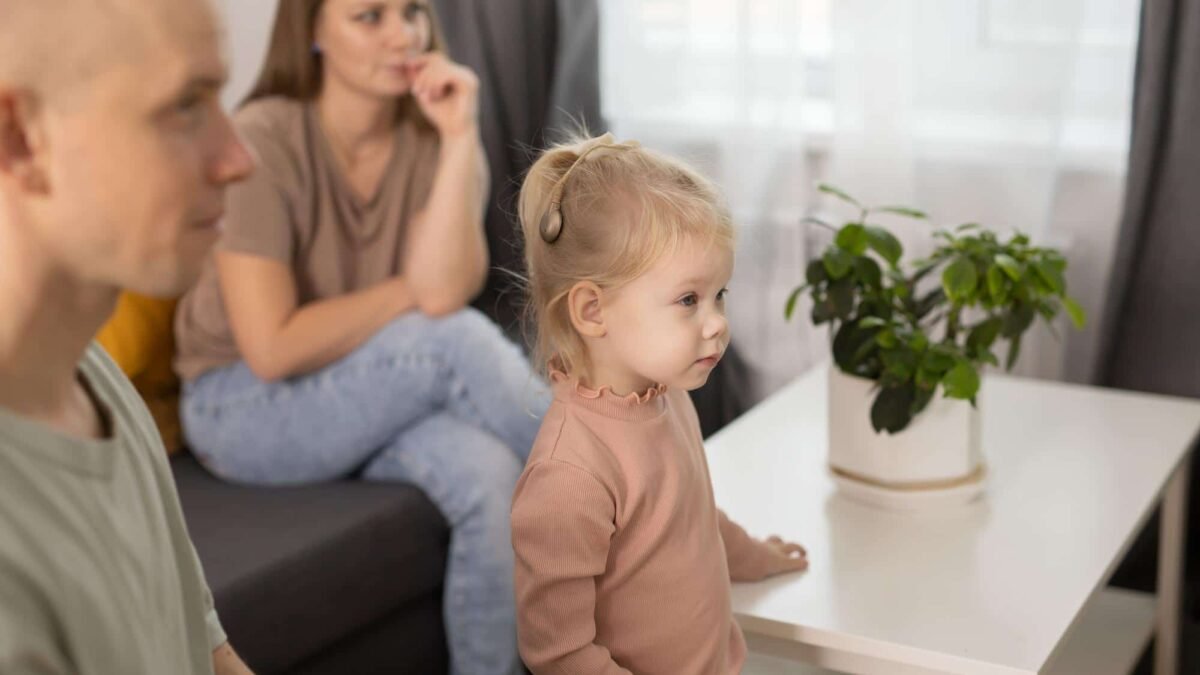
The father stares at his phone while his eight‑year‑old spins a fork in cold pasta. The girl starts talking about a fight at school, then stops mid‑sentence when she realises no one is really listening. Two tables away, a toddler cries as his mum hisses, “Stop it, you’re embarrassing me,” without looking up. The scene lasts barely a minute, then the restaurant swallows the moment and moves on.
Places like this are full of children who look “fine” on the surface. They get good grades, wear clean clothes, know how to say “please” and “thank you”. Inside, a different story is brewing: quiet resentment, anxiety, or a strange emptiness they can’t name. Long before they slam doors as teenagers, the groundwork is laid in tiny, repetitive attitudes at home.
Psychologists have been mapping these patterns for decades. Some of them are subtle. Some look like love. All of them chip away at a child’s happiness in slow motion.
1. Conditional love disguised as “high standards”
On paper, ambitious parents look admirable. They talk about “bringing out your full potential” and “not wasting your talents”. Kids in these homes get applause when they win, smile, perform. When they mess up, the room goes cold. The affection drops half a degree.
Psychology calls this conditional regard: warmth and approval that rises and falls depending on achievement or behaviour. Children quickly learn the script. Be impressive, be obedient, be easy – and love will stay. Be messy, sad, mediocre – and love might leave. What looks like motivation often feels like quiet terror from the inside.
Research from the University of Haifa found that parental conditional positive regard boosts compliance in the short term but increases resentment and shame long term. The child doesn’t hear “I want you to do your best.” They hear “You are my project, not my person.” Over time, happiness is replaced by a constant scan: “Am I enough today?”
Picture a ten‑year‑old who brings home a maths test with 18/20. Her mother’s first reaction: “Where did you lose the two points?” The girl laughs it off, but her shoulders drop almost imperceptibly. She decides not to show the next test at all.
Or the boy who loves drawing but slowly abandons it, because what really lights up his dad’s face is football. He stays late at practice, not out of passion, but because those car rides home are the only times his father truly talks to him. Adults call it “commitment”. His nervous system calls it survival.
Longitudinal studies on perfectionism in children show strong links with parental expectations and criticism. Kids who grow up in conditional‑love climates report more anxiety, depressive symptoms, and chronic self‑doubt. They internalise an equation: performance = worth. Joy shrinks. Curiosity feels risky. Failure becomes a personal verdict instead of normal human life.
What makes this attitude so hard to spot is that it often comes with real sacrifice: extra lessons, time, money. The child senses the investment and feels guilty for not being permanently grateful. That guilt can be as corrosive as open hostility.
2. Emotional invalidation dressed up as “toughening them up”
Some parents don’t forbid emotions, they simply downgrade them. Tears are “drama”. Fear is “being silly”. Anger is “disrespect”. A child says, “I’m scared of sleeping alone,” and hears, “Don’t be a baby.” In the short run, it can look efficient: fewer outbursts, faster bedtimes, a “resilient” kid.
On a biological level, something else is happening. When a child’s feelings are regularly dismissed, their body still experiences the emotion, but now with an added layer of shame. They learn not that feelings pass, but that feelings are wrong. Over time, they either explode or go numb. Both options eat away at happiness.
On a rainy Tuesday, a seven‑year‑old falls on the playground. His knees sting, eyes fill. Before the teacher can move, his dad calls from the bench, “You’re fine, get up, don’t make a scene.” The boy forces a laugh, limps up, and looks away. That night he refuses to talk about school, then wakes from a nightmare he can’t quite explain.
We’ve all seen the teenager who says “whatever” with a blank face when something clearly hurts. That flatness often started years earlier, with a series of micro‑messages: “Your insides are inconvenient to me.” In one clinical study on emotional invalidation, adults who grew up with dismissive parents showed higher rates of self‑harm and emotional dysregulation, even if their childhoods looked “normal” on the outside.
Children need two things when emotions surge: containment and naming. Containment says, “Your feelings can be big, but they won’t break us.” Naming says, “This is sadness, or jealousy, or disappointment, and it makes sense.” When instead they get minimising or mocking, they stop bringing their inner world to the relationship. Happiness without emotional safety is basically just good lighting on a shaky stage.
3. Overcontrol disguised as “being a responsible parent”
Hovering parents rarely see themselves as controlling. They see risk everywhere: in friendships, online spaces, streets, even boredom. So they curate everything – from the clothes their child wears to which sport they “should” like. On the surface, that child looks secure. Inside, they feel watched, not trusted.
Psychologists talk about autonomy as a basic psychological need, on par with connection and competence. When parents micro‑manage every choice, kids don’t get chances to practice judgment, handle consequences, or feel capable. Life becomes something that happens to them, not with them. That’s a perfect recipe for helplessness and low mood.
Imagine a 12‑year‑old whose weekends are scheduled minute by minute. When friends ask him to hang out, his mother answers for him. She checks his messages, picks his hobbies, speaks to teachers about every minor conflict. When things go wrong, he hears, “Why didn’t you do it like I told you?” In therapy a few years later, he struggles to name anything he actually wants, besides silence.
Long‑term studies on “helicopter parenting” link it to higher anxiety, poor coping skills, and less life satisfaction. The strange twist: these parents usually act from love and fear, not malice. They want to protect their kids from pain and failure, yet these are exactly the experiences that train resilience. A childhood with no room for small, safe mistakes often leads to adulthood where even small challenges feel like cliffs.
When a child never hears “You decide” or “How do you want to handle this?”, they don’t get the internal message, *I can influence my life*. Happiness needs that sense of agency. Without it, success feels like someone else’s plan, and failure feels like doom.
4. Emotional neglect hidden behind material comfort
Walk into some homes and everything looks perfect. Fresh paint, good schools, holidays, extracurriculars. What you can’t see in a photo is how often the adults kneel down, make eye contact, and genuinely listen. In many families, kids are well provided for but emotionally underfed.
Emotional neglect isn’t about screaming or hitting. It’s about moments that never happen. No one notices the quiet sadness after a birthday party. No one celebrates the tiny triumph of speaking up in class. The child’s inner world floats around, mostly unreflected. They learn to stop expecting to be understood.
On a Sunday night, a 14‑year‑old lingers in the kitchen while her parents talk work. She starts to say, “I think my friends don’t like me anymore,” then swallows it when her mother’s phone rings. The conversation never returns. She scrolls in her room for three hours instead, feeling strangely heavy for reasons she can’t quite pin down.
This is often the moment where people say, “But they had everything growing up, why are they so unhappy?” Studies on childhood emotional neglect show that what’s missing can hurt just as much as what’s overtly abusive. Adults who grew up this way often describe an internal blankness, a sense that their feelings are “too much” or “not real”. They minimise their own pain almost automatically.
What makes this particularly tricky is that many emotionally neglectful parents were neglected themselves. They may be kind, hardworking, and physically present, yet unskilled in tuning in. When kids don’t get that steady sense of being seen and held in mind, their nervous system leans towards loneliness, even in a crowded house. Happiness feels like something other people have.
5. Role reversal: when children become the parents
Some kids grow up with a job they never applied for: emotional caretaker. They comfort a depressed parent, mediate fights, manage siblings, or take on adult worries about money and health. This parentification can look like maturity. Teachers call them “so responsible”. Inside, it often feels like quiet exhaustion.
Psychology distinguishes between instrumental parentification (doing adult tasks) and emotional parentification (being a confidant, therapist, or partner substitute). The second type is particularly linked with later depression and guilt. The child learns that their needs are less urgent than the adult’s. They become experts in other people’s moods, strangers to their own.
On a Tuesday evening, a nine‑year‑old rubs her mum’s back as she cries about her divorce. The girl says, “It’s okay, I’ll take care of you,” and means it. Later, when she feels scared about a school presentation, she says nothing. Her role is to be the strong one. Years later she wonders why asking for help feels like breaking a law.
Studies on parentified children consistently show higher levels of anxiety, role confusion, and difficulty forming equal relationships. They often grow into adults who over‑function in friendships and romance, choosing partners they can “save” and feeling lost when someone actually looks after them. Happiness for them is tangled up with usefulness: if they’re not fixing someone, they feel worthless.
This dynamic usually grows out of adult pain, not cruelty. A lonely or overwhelmed parent reaches for the nearest supportive person: their child. The line between sharing and leaning too hard is subtle. The cost, though, is clear. When a child spends their energy managing adult emotions, there’s little left for play, exploration, or simple carefree joy.
How to shift toward healthier, happier parenting attitudes
None of this means raising happy kids requires walking on eggshells. What shifts everything is less about perfect techniques and more about daily posture. One simple practice many family therapists suggest is the “10‑minute no‑agenda check‑in”. Sit with your child, phones away, and let them lead. Ask open questions, reflect what you hear, don’t fix.
Another concrete move is to separate behaviour from identity out loud. Swap “You’re so messy” for “This room is messy.” Replace “Why are you always so dramatic?” with “This is a big feeling, huh?” It sounds small, but language shapes how children see themselves. When they mess up, you can name the mistake without touching their worth.
For overcontrol, experiment with “choice brackets”. Offer two acceptable options and let them pick: “Homework now or after snack?” “Blue shirt or red?” Later, with teens, extend this to bigger areas: budget decisions, screen time agreements they help design. Incremental autonomy tells their brain, “You’re learning to steer your own life,” which is deeply protective against hopelessness.
The trap many parents fall into is all‑or‑nothing thinking. They hear about conditional love or neglect and instantly replay every sharp word or distracted evening. Shame kicks in, and with it, paralysis. The reality: relationships are built on patterns, not single days. Kids don’t need flawless adults. They need adults who notice, repair, and gradually change direction.
Soyons honnêtes : personne ne fait vraiment ça tous les jours. Some nights survival mode wins. Some mornings, you shout. One powerful strategy is naming it and circling back: “I was really harsh earlier. That wasn’t about you. I’m sorry. How did it feel?” Repair moments are like emotional vitamins. They teach kids that conflict isn’t the end of love, just a messy part of it.
“Children are like emotional archaeologists. They dig through your daily behaviour and quietly build a story about who they are and how safe the world is.”
Small, steady adjustments in your attitudes change the story they find. To stay grounded, many parents keep a short “north star” list on the fridge:
* Connection before correction: listen first, guide second.
* Curiosity over control: ask what’s going on inside them.
* Effort over outcome: praise courage, not just success.
* Repair over perfection: own your mistakes and reconnect.
A different way of looking at “happy children”
We often picture happy kids as the ones who laugh loudest at birthday parties or pose easily for family photos. Psychology paints a quieter picture. Genuine wellbeing looks more like this: a child who feels safe to bring their whole self into the room. Who dares to be ordinary sometimes. Who can be sad without fearing love will vanish.
When you start noticing these nine attitudes – conditional love, emotional invalidation, overcontrol, neglect, role reversal, and their cousins – you may spot them not just in your home, but in your own childhood. That recognition can sting. It can also be strangely freeing. You understand why certain tones make you flinch, why your own happiness has always felt slightly out of reach.
On a practical level, change rarely arrives with a grand speech. It creeps in through different micro‑choices: pausing before dismissing a feeling, letting them try and fail, saying “I was wrong” out loud. The shift is often so subtle that only your child’s nervous system really notices. The house feels a little softer. Arguments are still there, but less brittle.
On a bus or in a café, watch the next parent‑child pair you see. The way the adult responds to a stupid joke, a clumsy spill, a small confession – that’s where a child’s future mood story is being quietly written. We rarely know, in real time, which sentences will echo for years. That’s both the terrifying part, and the hopeful one.
How do I know if I’m using conditional love without realising it?
Can a few years of “bad” parenting be reversed later on?
What if I was emotionally neglected and don’t know how to be present?
Is being strict always harmful to children’s happiness?
When should I consider professional help for my child?