The pasta is boiling, the chicken is half-cut, and somewhere under a pile of packets hides the garlic you swore you bought yesterday.
You bounce between fridge, cupboard, sink, stove. The timer beeps, your phone vibrates, a pan spits oil like it’s angry with you. Dinner will be fine, but you already feel drained. Not by the cooking. By the chaos around it.
That quiet stress has a name in your head: “Why does this take so long?” You blame the recipe, the ingredients, your knife, your pan. Rarely the room you’re moving inside. And yet, your kitchen layout is doing more than any gadget to slow you down. One tiny change can flip the script.
The wild part? You don’t need a new tool, a remodel or a bigger budget.
The real reason your cooking feels slow
Stand in your kitchen for a second and notice how you move. Most people cook in zigzags. Fridge to sink, sink to bin, bin to stove, stove back to fridge. It looks busy, it feels productive, but it’s secretly stealing minutes from every meal. Those minutes add up to a lot of evenings lost to walking in circles.
Your tools may be sharp and your spices fancy, but if you have to cross the entire room just to throw away a carrot top, your dinner will drag. That frustration you feel at 7:30 p.m. is less about the recipe and more about your routes. Your kitchen works against your natural flow, like a badly designed supermarket aisle.
On a recent time-and-motion study in home kitchens, coaches noticed the same pattern. People spent as much time reaching, searching and walking as they did actually cooking. One woman making a simple stir-fry clocked 37 trips between sink, fridge and stove in under 25 minutes. Her knife skills were great; her layout was a maze.
When she moved her chopping board closer to the bin and pulled a cheap trolley next to the stove for oils and condiments, her steps dropped by half. Same dish. Same pan. Same ingredients. She finished eight minutes faster and felt less rushed. That’s the hidden tax of a scattered workspace: you pay with your time and your patience.
We love to think speed in the kitchen comes from learning new techniques or buying a pressure cooker. Those things help, sure, but they sit on top of a deeper structure: where your stuff lives and how your hands move. The simple truth is that your brain hates friction. Every time you hunt for scissors, spin around for salt, or lean over the sink to reach a strainer, you’re burning focus.
Rearranging is about removing those tiny frictions so your body glides through the same old recipe. Less hunting, less pivoting, fewer decisions. Once your kitchen “route” is clean, your normal pace feels naturally faster. Not rushed. Just smooth.
The one rearrangement that changes everything
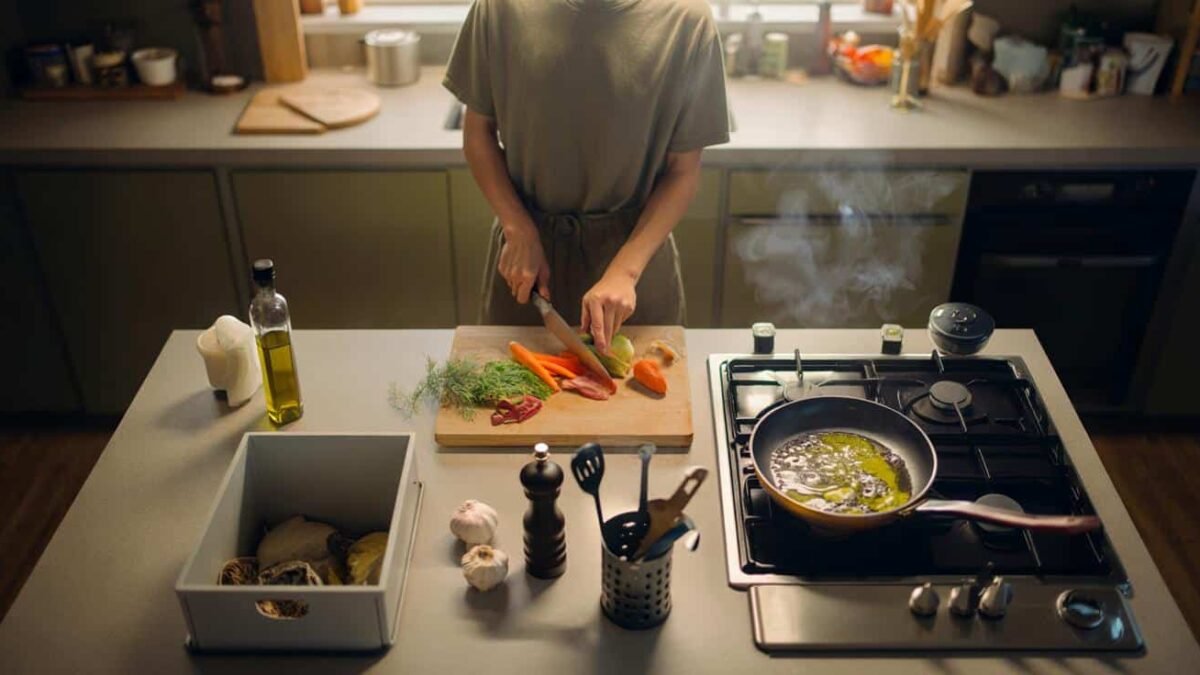
The move that quietly transforms weeknight cooking is this: create a tight “cooking triangle” that pulls your chopping, trash and heat source into one small zone. Not a whole-kitchen renovation. Just a deliberate cluster. Cutting board front and center. Trash or compost right beside or under it. Stove within one or two steps, not behind you and across the room.
That’s the rearrangement. You reduce how many times you cross the room with dripping spoons and armfuls of peelings. Your raw food goes from fridge to board to pan in a clean line, not a shuffle. Once this triangle exists, everything else in the kitchen becomes supporting cast, not constant distraction.
On a practical level, this can look incredibly basic. Slide your bin from under the sink to right under the edge of the counter where you chop. Move your portable induction hob, or your most-used frying pan, to the spot nearest that board. Shift a small shelf or tray to hold salt, oil, pepper and your everyday spatula right beside the heat. Suddenly, every vital move happens within the width of your shoulders.
Many people try to cook efficiently while their core tools live in three different corners. Then they blame themselves for being “slow” in the kitchen. That’s not slowness. That’s a layout that scatters your attention and your energy.
Think of your kitchen as a stage. If your main actor keeps leaving the scene to fetch props, the play feels messy. The cooking triangle keeps the scene tight. Knife, bin, heat. Everything else orbits quietly around that center.
The logic is simple: walking is not cooking. When you cluster your movements into one compact arc, your hands spend more time transforming food and less time transporting it. You cut the number of micro-decisions too. No more “Where did I put the spoon?” or “Which drawer has the peeler?” Your most-used items live where you actually stand during 80% of your cooking time.
There’s a mental shift too. A defined cooking zone tells your brain, “This is where the work happens.” That physical boundary makes it easier to enter a flow state. Less spinning around, less cross-room shouting, more continuity. You’re building a tiny factory line, but one that still feels like home.
How to rearrange your kitchen in under an hour
Start by watching yourself cook just once. Don’t change anything yet. Notice where your feet land, where your hips turn, where your hand automatically reaches. Then pick the spot where you chop most often and crown it as your new “command center”. That single decision guides everything else.
Bring a bin or compost caddy as close as you can to that board. Slide a small bowl there if you can’t move the bin. Place your pan or pot on the burner closest to that spot. Pull oil, salt, pepper, garlic and your favorite stirring tool into arm’s reach of that burner. You’re shrinking your world to a two-step bubble.
Soyons honnêtes : personne ne fait vraiment ça tous les jours. So treat it like a one-time reset, not a lifelong project. Empty one drawer that’s far away from your cooking triangle and refill it with things you only use occasionally: baking tins, special gadgets, the weird melon baller you forgot you owned.
Then raid a drawer or shelf near your triangle and move in the everyday heroes: sharp knife, cutting boards, tongs, spatulas, a strainer. On a small counter, you might stack boards vertically and drop utensils into one heavy mug. It doesn’t need to look like a design magazine. It just needs to support that tight route from raw to cooked.
On a mobile kitchen cart or tiny island, the same rule applies. Keep the cart parked between sink and stove, not stranded against a random wall. That way you can pivot from rinse to chop to cook, almost without moving your feet.
“The biggest time-saver in my kitchen wasn’t an appliance,” says Laura, a single mum who batch-cooks on Sundays. “It was admitting that walking ten steps to the bin thirty times a night was just… silly. I moved everything into one corner and suddenly my lasagna didn’t feel like a marathon.”
There are traps to avoid. One is turning your countertops into a storage unit. If every inch is crowded with appliances, you lose the clear space needed for your triangle. Another is perfectionism. You don’t need labeled jars and color-coded drawers to benefit from a smarter layout. You just need your most-used stuff where your hands actually work.
- Keep only active tools in your triangle: today’s ingredients, today’s pan, today’s utensils. Yesterday’s mail, keys and chargers belong elsewhere.
- Group by action, not by category. Things you grab while frying live by the stove, even if they’re “pantry items”.
- Set a “reset minute” after dinner: 60 seconds to slide the board back, return oil and salt to their spot, and empty the scrap bowl. Tomorrow’s speed starts tonight.
Once this simple rearrangement is in place, you’ll notice it in small, almost boring ways. On a Tuesday night when you’re tired, pasta goes from idea to plate quicker than your streaming show’s opening credits. A big weekend recipe feels less like an event and more like a relaxed rhythm. You waste less food, too, because things are visible and reachable.
On a deeper level, the kitchen stops being a place where you “fight” the mess and starts feeling like a tool that’s on your side. That changes how often you say yes to cooking. It shrinks the gap between wanting to make something fresh and actually doing it. That’s where the real gain hides: not just in minutes saved, but in the number of nights home-cooked food becomes realistic.
On a bad day, when work ran late and everyone’s hungry, you’ll be grateful your body knows exactly where to stand and what to reach for. On a good day, the same setup lets you play with new recipes because the basics run on autopilot. And we’ve all had that moment where a simple dish turned stressful for no clear reason.
This small rearrangement doesn’t scream for attention. No flashy gadget, no huge reveal. It sits quietly in the way your feet move and your hands flow. Yet it might be the most powerful kitchen upgrade you can make without spending a cent. The kind of change you only notice when you cook somewhere else and wonder why their perfectly nice kitchen suddenly feels so slow.
Do I need a big kitchen for this rearrangement to work?
What if I can’t move my built-in stove or sink?
How long does it usually take to rearrange a kitchen like this?
Will this help if I already cook pretty fast?
Can this setup work when several people cook at the same time?